16-Day Peru & Chile Family Trip: Exploring Machu Picchu, Skiing in Valle Nevado & Atacama Desert Stargazing
This summer vacation, just like last summer, we headed south of the equator for a 16-day family adventure through Peru and Chile. From Machu Picchu and the Sacred Valley to skiing in Valle Nevado and gazing at the incredible skies of the Atacama Desert, this trip took us from ancient Inca cities to some of the highest and driest landscapes in South America.
Our 16-Day Peru & Chile Itinerary at a Glance
- Lima: 1 day
- Sacred Valley & Ollantaytambo: 3 days
- Machu Picchu: 1 day
- Cusco: 2 days
- Valle Nevado: 3 days
- Santiago & Valparaíso: 2 days
- Atacama Desert: 4 days
We traveled as a family of four and did not rent a car during this trip. The itinerary combined ancient Inca sites, high-altitude adventures, South American skiing, coastal cities, and some of the world's best stargazing.
Stop 1: Lima, Peru
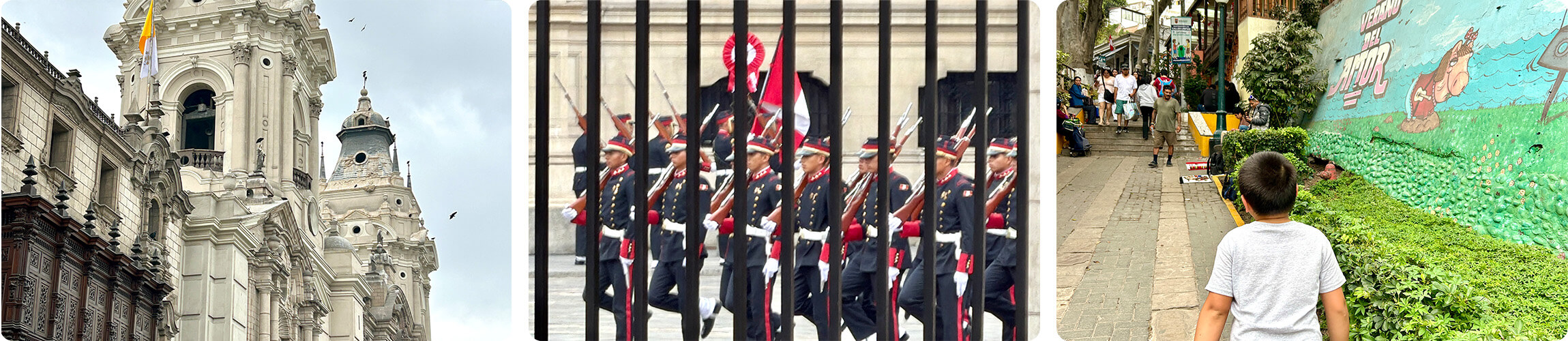
Our first stop was Lima, the capital of Peru. I suspect many travelers are like us and come here mainly as a gateway to Machu Picchu. Since we were already here, we figured we might as well check it off the list.
The Cathedral was nice, but honestly, it didn't have the grandeur of European cathedrals. The changing of the guard at the Presidential Palace was another “tourist attraction,” although the authorities kept everyone about a hundred meters away. Though the seaside parks were nice, coming from California, we were a little spoiled.
And the graffiti district… pretty similar to graffiti streets everywhere else, except for the artwork itself.
An important thing to know is that English isn't widely spoken there. This was the first time I truly appreciated how amazing translation apps are. We quickly checked Lima off the list and moved on.
Stop 2: Sacred Valley, Peru
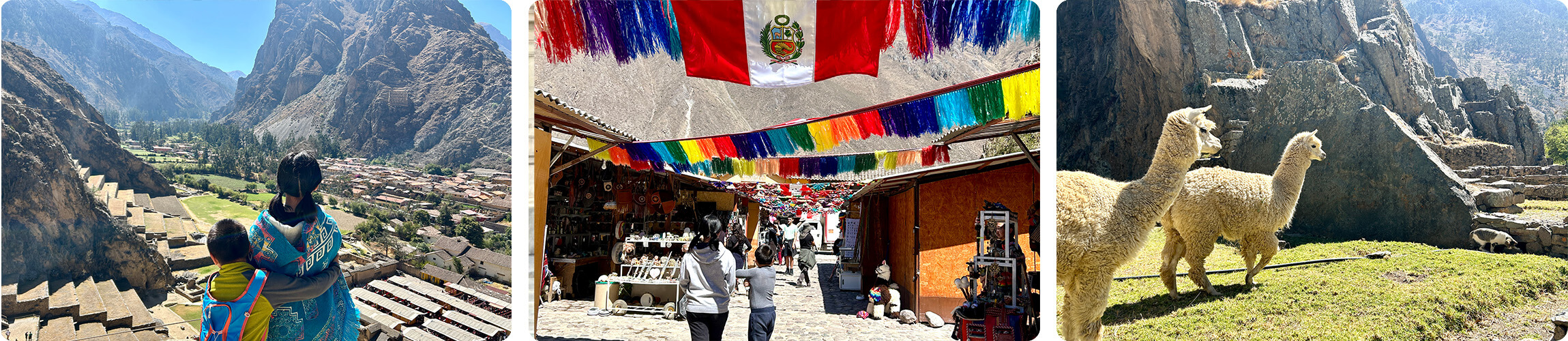
From Lima, we flew to Cusco. According to all travel guides, Cusco sits at more than 3,500 meters (11,500+ feet), making altitude sickness a real possibility. So rather than staying in Cusco, we immediately headed down to the Sacred Valley, at around 2,000 meters (6,500 feet), to give our bodies some time to acclimatize.
The Sacred Valley was essentially the breadbasket of the Inca Empire. And honestly, it makes perfect sense. Look at the terrain: mountains, rivers, and a relatively mild climate. Snowmelt from the Andes feeds the Urubamba River, which runs through the entire valley.
Despite all that traveling, we still hadn't reached our actual destination yet, but we were getting close!
Cusco ✈️ → Sacred Valley 🚗 → Aguas Calientes 🚞 → Machu Picchu 🚌
A big shocker was what lay on our plates for dinner: a whole guinea pig! It's a traditional Andean dish—not a pet on the dinner table.
After two days in Ollantaytambo, a town in the Sacred Valley, we took the train to Aguas Calientes. The train ride was surprisingly fun. They really know how to turn a simple train ride into a party.
The Inca Rail tracks followed the Urubamba River through the valley. Its route ended at the gateway town of Machu Picchu.
There is of course a much more hardcore way to get to Machu Picchu: the famous Inca Trail. Instead of taking a car, train, and bus, you can hike the classic route for four days—or even a full week. That's how people traveled to Machu Picchu centuries ago. But after thinking about it for a second, I decided I was good with the train.
Stop 3: Machu Picchu
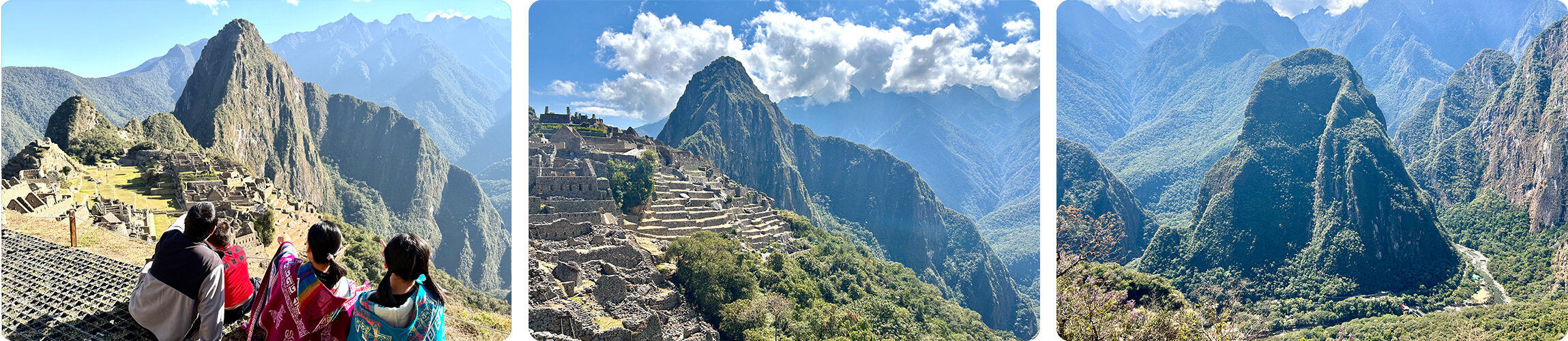
Finally!
One of the New Seven Wonders of the World, often called the “Lost City of the Incas,” Machu Picchu was finally right in front of us. No written records tell us exactly what Machu Picchu was built for, but historians generally believe it served as a royal retreat and ceremonial center for the Inca elite. Of course, we found all the classic photo spots, for a stunning, absolutely breathtaking view.
To be honest, the famous Inca engineering didn't completely blow me away. The precisely fitted stonework, agricultural terraces, solar observations, and sophisticated drainage systems were impressive, but many similar engineering achievements can be found at other ancient sites around the world.
What really amazed me was the location. And that extraordinary location is probably one of the main reasons Machu Picchu survived. The Spanish conquistadors never discovered it, so unlike many other Inca sites, it wasn't destroyed.
Let me explain why the location is so iconic. First, there's Aguas Calientes, where we stayed the night before visiting Machu Picchu. Historically, this town didn't exist. It essentially grew around Machu Picchu after the site was rediscovered and the railway was developed in the early 20th century. Surrounded by dense jungle, it feels remarkably hidden. Most visitors take a bus from here, winding up the mountain for about half an hour.
Second, from the ancient city itself, you don't immediately realize how strategically it was positioned. Machu Picchu was built along a mountain ridge, blending almost perfectly into the surrounding peaks, clouds, and forest. Place yourself in the shoes of a Spanish explorer: when you look above you, from down by the river, all you see is endless sky and lush green forest. There's absolutely no trace of humanity on the mountains when viewed from below.
Finally, the Urubamba River loops around the foot of the mountain. It provides water, but it also creates a natural defensive barrier. Could you ask for a better location?
While exploring, we learned a small but important lesson at Machu Picchu, the hard way:
We didn't do enough homework beforehand. We figured we'd just hire a guide once we got there. Guides weren't particularly expensive, so why not? The problem is that Machu Picchu's sightseeing routes are essentially one-way. Our guide walked us through the site quickly in about two hours, and then he was off to find his next client. We wanted to wander around and explore on our own afterward. Nope. Once we were near the exit gate, we couldn't go backwards. After all that effort getting there, our entire Machu Picchu experience was basically over in two hours. I was NOT ready to leave. So learn from our mistake: check the circuit rules carefully and choose your ticket/circuit before you go! Another person from our tour group bought two tickets for two different circuits, so she got to see this wonder twice. I thought that was a great idea!
Stop 4: Cusco & the Surrounding Inca Sites
Cusco was the historic capital of the Inca Empire, sitting at more than 3,500 meters (11,500+ feet). By the time we returned, we had already spent four or five days at around 2,000 meters. Although we were still a little breathless when walking uphill, none of us experienced the dizziness or fatigue we'd feared.
As for Cusco itself… it's hard to describe. We stayed in the historic center, where the cobblestone streets and stone walls give the city a wonderful old-world character. And it was surprisingly clean. On the road to the Sacred Valley, we passed through the outskirts of Cusco, where there were so many stray dogs eating garbage along the roadside. Peru has plenty of stray dogs, but this was the first time we'd seen so many literally living off roadside trash.
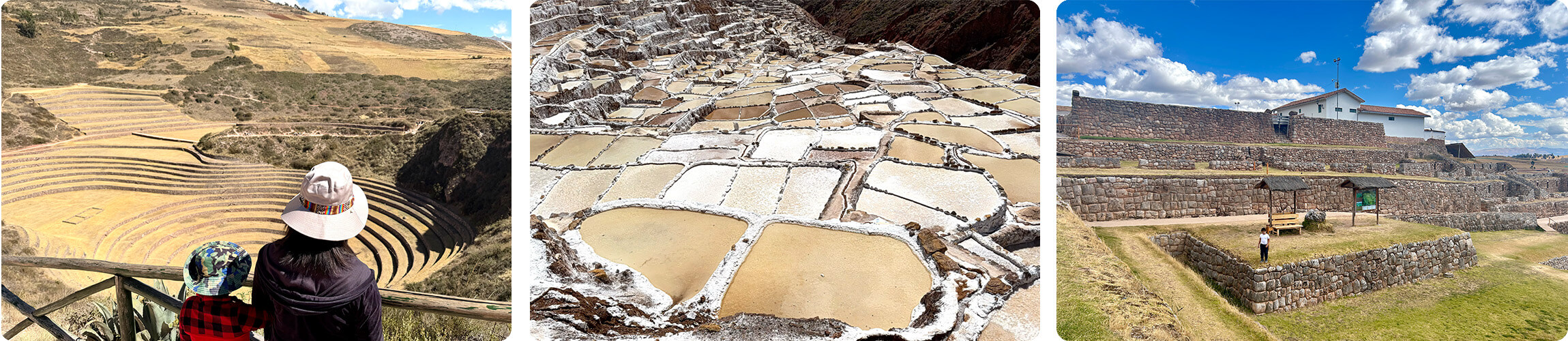
There are several fascinating archaeological sites around Cusco that are worth visiting. You can visit them as part of a Sacred Valley tour or arrange a separate day trip.
Moray: These extraordinary circular terraces are believed to have been used for agricultural experimentation by the Incas. Each level has slightly different temperature and humidity conditions, while the circular design allows sunlight to reach the terraces more evenly. The Incas were particularly proud of their agricultural achievements. They cultivated more than 1,000 varieties of potatoes and hundreds of varieties of corn.
Maras Salt Mines: Another remarkable example of how people adapted to this challenging environment.
Chinchero: Chinchero is a beautiful old Andean town. In the center, a Spanish colonial church was built directly on top of Inca stone foundations. It's a little bittersweet to see. The Spanish conquest of the Inca Empire is one of the most dramatic episodes in South American history. Spanish military technology played an important role, but disease, particularly smallpox, as well as internal divisions within the empire also contributed to the collapse of the Inca state. It is a painful example of how devastating the combination of military technology and disease can be. Fortunately, descendants of the Incas still preserve much of their ancestral language, culture, traditional crafts, and festivals today. They call themselves Quechua. And interestingly, Machu Picchu means “old mountain” in Quechua.
Stop 5: Valle Nevado
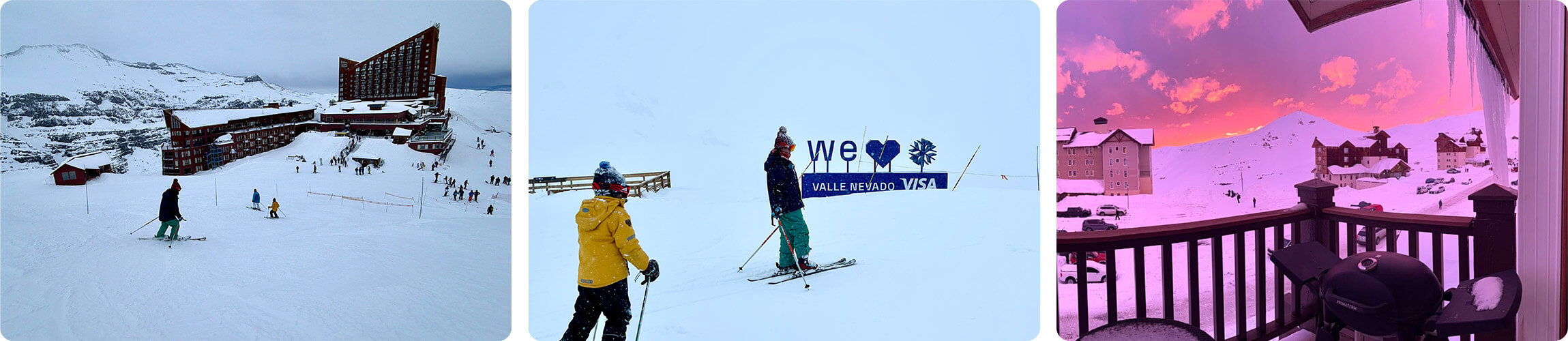
Next stop: Valle Nevado, one of the largest ski resorts in South America. At more than 3,000 meters (10,000+ feet), it offers spectacular views of the Andes. Many North American skiers actually fly to Chile during the Northern Hemisphere summer to ski here. Our family absolutely loves to ski, so we were really excited to add some South American skiing to this trip. And the snow conditions were surprisingly good too!
Getting to Valle Nevado is relatively straightforward compared with getting to Machu Picchu. We flew from Cusco to Santiago and, without spending much time in the city, took a bus up to Valle Nevado and stayed there for three days. In theory, you could stay in Santiago, and make day trips to the ski resort, and a lot of people do so. Traffic can be unpredictable. On the day we went up, what should have been a two-hour ride took 4.5 hours. The reason? On snowy days, drivers have to stop to have snow chains installed before approaching the top of the mountain. This is very similar to what happens at one of our home ski areas Big Bear Lake in California. Every time it snows, traffic heading up the mountain can become a disaster, with many cars just stopping in the middle of the narrow road to install snow chains.
For the first two days, we skied through wind and snow. Everything was white, and we could barely see anything beyond a few meters. Then, on our third day, the wind finally blew a hole through the thick cloud cover, revealing the magnificent mountain peaks beyond. We were incredibly lucky. And just when we thought the day couldn't get better, we got to watch the sunset paint the entire mountain range red. Absolutely unforgettable.
Stop 6: Santiago
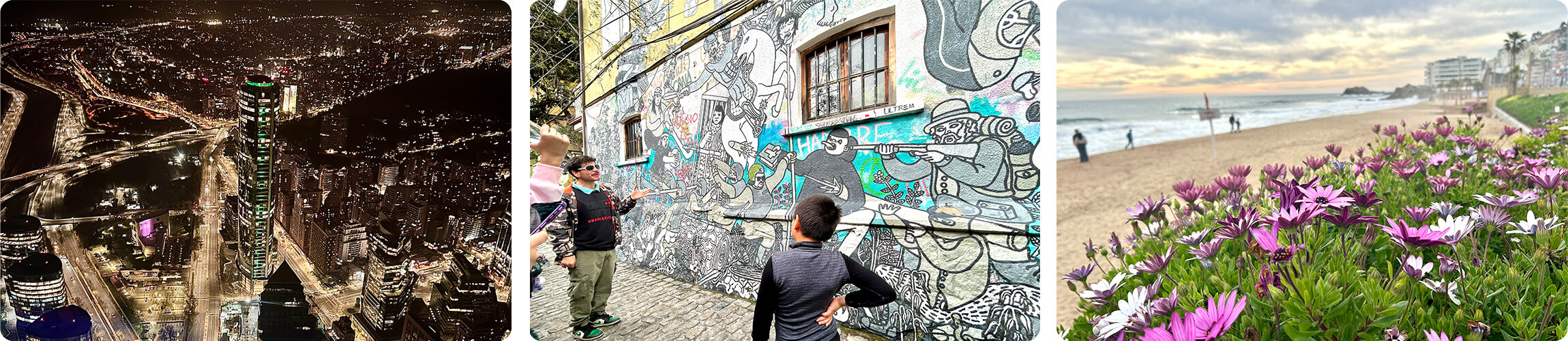
After skiing, We spent a full day touring Santiago. Santiago is the capital of Chile and a convenient base for exploring the surrounding area. Since we were here anyway, of course we had to check it off the list. From the top of Sky Costanera, you can really appreciate just how enormous and densely developed Santiago has become.
We then joined a group tour. The first stop was Valparaíso. Once one of Chile's most important ports, Valparaíso lost much of its importance after the opening of the Panama Canal redirected major shipping routes. Today, the city is famous for its colorful street art and graffiti, which attract tourists from around the world. But walking through the streets, you can still feel the melancholy of a once-prosperous port city that has seen better days. There are some old elevators in that area that people used to take instead of climbing up stairs, and many of them are run-down and not operating anymore.
You can also see historic buildings that survived some of the region's major earthquakes. In 1960, Chile experienced the largest earthquake ever recorded, measuring magnitude 9.5. The earthquake caused enormous destruction and loss of life, demolishing much of the city.
Viña del Mar is another coastal city near Valparaíso, but it feels noticeably cleaner and more polished. The coastline is beautiful too, and somehow it reminded me a little of the California coast.
Stop 7: Atacama Desert
We then flew from Santiago to Calama and took a 1.5-hour bus to San Pedro de Atacama. The Atacama Desert is one of the driest places on Earth—even drier than the Sahara. San Pedro de Atacama is essentially an oasis in the middle of the desert. You can see it clearly from the hills around town: a tiny, almost village-like settlement surrounded by an enormous, barren landscape, yet somehow attracting visitors from all over the world. There are plenty of other spectacular landscapes here, but the thing that impressed me most was what happened after the sun went down.
The Best Night Sky I've Ever Seen
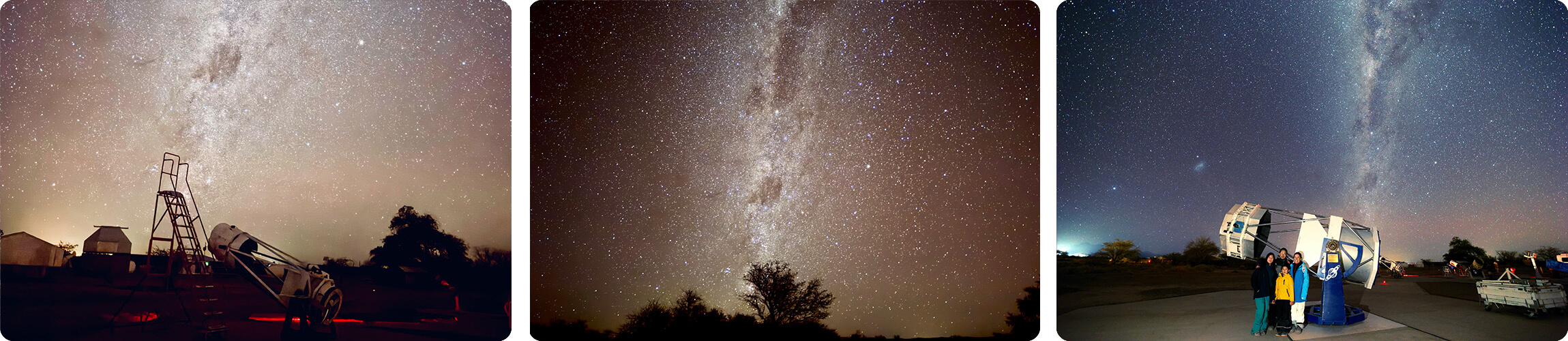
This was, without a doubt, the most incredible stargazing experience I've ever had.
Atacama has many huge advantages:
- Almost no light pollution
- Extremely dry air
- Very little cloud cover
- High elevation
- Exceptional atmospheric transparency
And during our stay, the moon didn't rise until after midnight, which was an extra stroke of luck. You could simply look up and feel like the Milky Way was directly overhead. Being in the Southern Hemisphere also gave us an incredible view of the Milky Way's Galactic Center and the Southern Cross, one of the most recognizable constellations in the southern sky. One word: WOW.
And yes, there are plenty of daytime wonders too. Atacama's other attractions are mostly natural landscapes and wildlife.
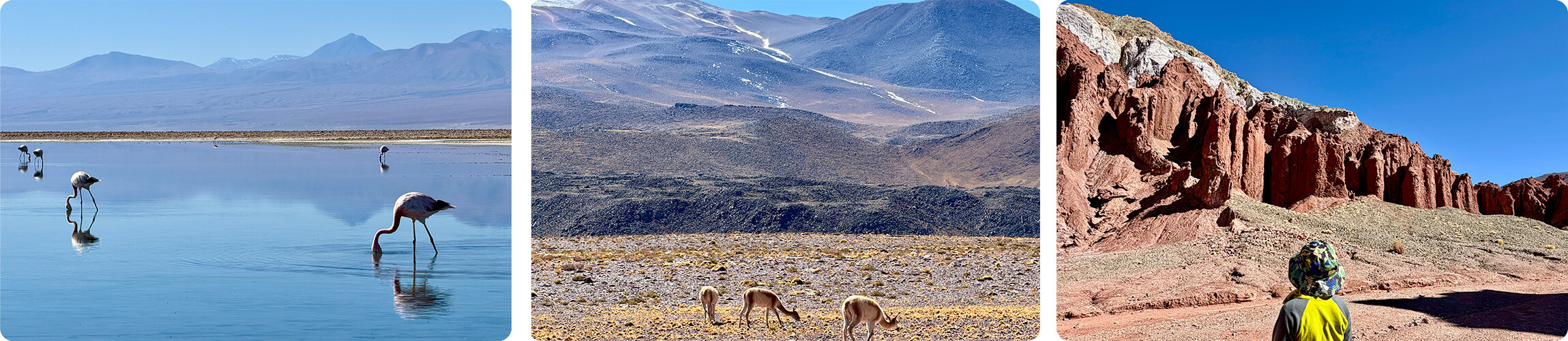
The wild flamingos looked completely relaxed, as if they owned the place. And there are vicuñas, the wild relatives of domesticated alpacas and llamas. And here's another interesting local story: our guide told us that some donkeys introduced by the Spanish eventually became feral in the region. Apparently, after people realized how useful llamas and alpacas were in this environment, not every introduced animal remained part of everyday life. The landscape is so vast and harsh that some animals have adapted surprisingly well. And yes, there are stray dogs here too, just like in Peru. They're everywhere. Our guide told us that despite looking dusty and scruffy, the extremely dry environment and mineral-rich water make the local conditions surprisingly inhospitable to many bacteria.
More Atacama Desert Landscapes We Visited:
Piedras Rojas & Altiplanic Lagoons: Red rocks and high-altitude lagoons.
Valle de la Luna: Moon Valley.
Valle del Arcoíris: Rainbow Valley.
Final Thoughts: What We Learned Traveling Through Peru & Chile
After this trip, I came away thinking that some places are worth visiting while you're still in good physical shape. Peru and Chile are beautiful, but they are not exactly easy destinations. A lot of the attractions sit at 3,000–4,000 meters (10,000–13,000+ feet). Even when you're traveling with a tour group rather than doing hardcore trekking, it's easy to walk 10,000+ steps a day. And the conditions can be pretty rough. Wind, dust, altitude, long drives, early mornings… every day felt like we were coming back covered in dust. I swear I inhaled more dust during these two weeks than I had in the entire previous year.
Food was another lesson learned the hard way. I got a little too confident and ended up with a few days of stomach trouble, as did my son. Let's just say raw salads were not our friends.
But after all the altitude, dust, long drives, trains, buses, planes, snowstorms, deserts, mountains, ancient cities, star-filled skies, and endless landscapes. My daughter summed up the whole trip perfectly: "You have to see a world different from your own to realize how nice home really is."
16-Day Peru & Chile Trip Cost for a Family of Four
Here is our complete breakdown of what we spent on a 16-day Peru and Chile trip for a family of four.
Includes flights from LAX to Lima, Lima to Cusco, Cusco to Santiago, Santiago to Calama, Calama back to LAX.
As usual, we were able to use points to stay in Lima, Cusco, and Santiago. However, in places like Ollantaytambo, Machu Picchu, Valle Nevado, and Atacama, there were fewer opportunities to use hotel points.
A mix of restaurants and fast food for the whole family. Surprisingly, eating in Peru and Chile isn't as cheap as we expected.
Includes LAX parking, train tickets from Ollantaytambo to Machu Picchu, and lots of taxis and buses. We didn't rent a car this time, which is unusual for our family.
We have an Ikon Pass, so our ski passes were covered. This expense includes admission to Machu Picchu and our guide, Sacred Valley archaeological sites and guides, tours in Santiago, Sky Costanera, tours around San Pedro de Atacama, and two stargazing tours.
Includes souvenirs and cash withdrawals in Peruvian soles and Chilean pesos.
Total Peru & Chile Trip Cost: $12,805.65
Average Cost Per Person: $3,201.41
Looking for detailed reviews of ski resorts? See our complete Colorado Ski Resort Reviews for Families.
Explore more family travel destinations.
Planning a winter trip to Japan? Read our Japan Winter & Ski Trip with Kids.
Planning a European ski adventure? Read our Swiss & French Alps Ski Trip with Kids.